 Have you ever wondered how 4D robotic vision systems work? How does a 4D robotic vision system detect random objects, pinpoint locations, and provide precision object placement for automated use? Choosing advanced precision robotic vision system technology could be the critical choice you make for the success of your automated requirements. While the demands for manufacturing productivity give rise to advanced automation requirements, its vision often hinders robotic systems. Apera AI 4D Vision is just the automated vision intelligence your business needs. Apera AI has developed its own highly advanced, human-like, 4D robotic vision system for today’s automated world. Our intelligent 4D vision software propels your robotic system productivity, regardless of the object you’re working with.
Basics of a 4D Robotic Vision System

Our innovative 4D robotic vision software has been designed to be adaptive and productive to a wide array of applications. We boast the industry’s fastest cycle times, resulting in a greater return on investment for your company. Our single capture technology incorporates robot systems earlier in the process, ensuring you get the benefit of the fastest pick-and-place system on the market. Our innovative 4D robotic vision software has built-in intelligence for rock-solid performance. Apera Vision Software comes equipped with machine learning which enables it to produce a level of accuracy and precision that is simply unmatched in the industry. In addition, you get a simple setup with our plug-and-play technology. You can get this premium, mass-customized solution which delivers the value of a high-end platform with the rapid and easy deployment of an off-the-shelf system.
Apera’s 4D Robotic Vision System involves four major components:
- A screen that provides a user interface that connects the operator with the robotic vision software. This user interface provides a holistic view of the performance and diagnostics of the 4D robotic vision system.
- An industrial PC preloaded with Apera Vue. The Apera Vue software connects to the robot controller using LAN (Local Area Network).
- Your choice of a robot system. Our vision system is compatible with virtually any industrial robotic system.
4D robotic vision systems also offer the advantage of significantly reduced cycle times over 3D robotic vision systems due to their reduced time spent capturing data, while still providing the robot with clear images. 3D robotic vision software is slower and not as adaptive as 4D vision software by nature. 4D vision software is revolutionizing robotic automation because it is more intelligent.
A 4D robotic vision system works by utilizing 2D cameras with the addition of artificial intelligence (AI). The software extracts 2D information such as shadows, edges, texture, and color from the 2D images just like a human would, to perform pose estimation and object recognition. This is an optimization for the robot’s image processing over a 3D image because the pose of the object is more accurately captured with 2D imaging. With Apera’s AI-based 4D Vision Software, the robot has more flexibility and freedom to perform the task at hand, providing excellent benefits of time savings and efficiency. The 4D vision system incorporates such robust AI technology that it can pay attention to a lot of information to provide to the robot, such as edges, occlusion, textures, and shadows. The intelligent software is also trained on geometry and shape of pictures, giving the ultimate control over what it should and shouldn’t ignore.
Interested in learning how a 4D robotic vision system can revolutionize your robot interface?
Contact the professionals at Apera AI to find out more about how we improve the speed of your industrial robotic processes.
The Problems 3D Robotic Vision Systems Face: Solved with Apera’s 4D Vision System
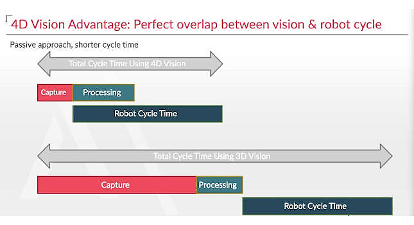
While traditional, 3D robotic vision systems are useful for specific applications, 3D vision systems have inherent limitations that are solved by Apera’s 4D robotic vision software.
These challenges fall into categories:
- Environmental
- Objectual
- Visual
The operating environment is the first challenge faced by 3D robotic vision systems. If you’ve ever taken a picture or video with a camera, you know that appropriate lighting is vital before capturing a clear image of your target. 3D robotic vision systems aren’t always capable of operating under varying environmental conditions. They are typically unable to produce a high-quality point cloud which is critical for better object recognition. Does your work environment have other moving robots or people in the manufacturing area? Your robotic visual system must be able to see and avoid moving objects, whether machinery or living. Will your 3D robotic visual system work in environments with infra-red or fixed lighting, or lasers for your manufacturing process? All of these have to be taken into account when selecting your robotic visual system.
The object to be handled during your manufacturing process must be considered in your 3D robotic vision system. What kind of material is your object made of? Is it soft, pliable, or hard? Does your object have a moving joint? A 3D robotic vision system must be capable of seeing these types of objects even if the overall shape changes. The distance, size, and even texture of your object also must be considered. A hindrance with common 3D robotic vision software is that it misses surface details. Very little 2D information is included in the 3D imaging process.
The last and most common challenge is the visual intake of the 3D robotic vision system during your manufacturing process. Each object may be at a different position or orientation as it runs through your manufacturing process. Your 3D robotic vision system must be able to detect your object’s position from all 3D angles as well as to detect the absence of objects. A 3D scene capture involves processing a lot of data through the imaging pipeline, most of which is not useful. This results in wasted time processing which slows down your manufacturing process.
The 3D robotic vision system visual background is also important. Is your manufacturing object visually detectable against its background? To help you visualize this, imagine a white golf ball placed on a background with images of golf balls printed all over it. How will your robotic vision system distinguish your object from the image background? What if part of your object is visually obstructed from your robotic visual system? This opens up a whole new set of robotic visual system challenges as in all other considerations above, the object was always fully visible. Can your robotic visual system operate under any camera placement angle or see your object as it moves down the assembly line? These are visual requirements that can only be met with an advanced 4D robotic visual system.
Apera Is Your Solution
Apera has fused 4D robotic vision system technology with 2D vision information for a fail-proof solution to all the aforementioned 3D robotic vision system automation challenges. Apera 4D Vision offers an easily configured and cost-effective platform that can be scaled up as your requirements grow. Apera Vision deftly handles a wide range of options for even the most complex tasks including:
- Recognizing glossy, reflective, or shiny products
- Discerning variable object features
- Consistent operation even in a variable environment
- Randomness on both picking and placing sides
- Texture-based pose estimation
- Tasks that involve a lot of control over recognizing when to ignore a piece of geometry
Apera’s 4D robotic vision software is the ultimate solution that utilizes a bit of old technology, paired with new and innovative technology to provide you with a new approach to machine vision and an unparalleled potential for your robot operation needs.
Apera AI is a Vancouver-based AI technology company that is developing innovative machine vision technology At Apera AI, we are proud to offer our customers the most advanced solution for your automation workflows. Our experts are redefining automation with AI-powered, ultra-fast, and ultra-reliable 4D robotic vision software. We are continuously investing in research and further development of our 4D Vision Platform.
Our 4D robotic vision software is optimized for a wide range of automation workflows, including:
- Belt Picking
- Bin Picking
- Automated Assembly
- Sorting
- Kitting
- Palletizing
- Machine Tending
- Packaging
Our goals, along with our industry partners, are to bring intelligent automation to businesses everywhere and make 4D vision a reality.
Get your automation on track with Apera 4D Vision. Contact Apera AI at +1 604 200 4544 to learn more about our innovative 4D technology.